 The Making Change Collective was started in 2015 by three of us (Alice Cutler, Eleanor Fairbraida and Jay Wilkinson) who’ve long been involved in social change work for a more equal, democratic, just and sustainable world. Much of our work up until this time had involved education and facilitation work, and we started the Making Change Collective to create space where we felt that something was missing – namely the deeper development of political ideas and ways to become active or more effective. As individuals involved in this project, we’ve recognized a common feeling of being overwhelmed by the seriousness and complexity of what’s happening in the world. Added to this, life pressures can sap our time and energy, health issues feel like a barrier, and it can be hard to find focus. We have put a lot of our energy into social change work in the past and seek more sustainable ways of engaging. We believe this to be the case for many people, and we aim to create spaces for participants to work through barriers to action and create a clearer vision for themselves of where they want to get to and how to get there.
The Making Change Collective uses the following as its foundation:
-
Popular Education as an educational approach.
-
The importance of collective learning and action.
-
A ‘radical’ approach to social change.
Popular education as an educational approach.
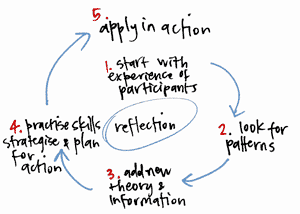 This is a form of adult education that has flourished at times of big social upheavals, when people have questioned the way the world is and see a need to change their lives. Popular Education works in the interests of people who lack power (live with oppression), creating spaces for people to work out together what they need to do to change the situation they are in.
Workshops start from the ideas, knowledge, and experience of the participants. This is then connected with a wider political, social and economic context to identify patterns that exist. In this way, participants can also start to identify unhelpful beliefs – one example being that there is nothing that we can do to change the situation we are in – as well as find ways of overcoming barriers to taking action. Learning is followed by planning for action. After the action has been taken, reflection and analysis are encouraged before the cycle begins again.
Facilitators of workshops are not ‘experts,’ meaning that the knowledge and experience of both facilitators and participants is seen as just as valid and needs to be shared to develop new and useful knowledge and perspectives. The role of the facilitators is to bring participants through a process of learning to action, asking challenging questions for participants to work with. Facilitators also work to ensure that everyone has access to participating fully in the workshop.
For a deeper look at Popular Education, click the link Here for a short chapter that explains more.
The importance of collective learning and action.
Collective learning is about the whole group learning from one another, developing together, and working out how to collectively transform their experience. This is in contrast to the way we are used to our education system working, which is about some individuals within a group achieving success and others failing. In learning together how the world works and why problems exist as they do, we find common identity in seeing that other people face the same difficulties that we do. We also develop better understandings of diversity; that other people in the group come from different backgrounds and have different experiences of oppression. By seeing patterns that exist in the systems we have, we can come to see that what we believe to be our fault is actually not, and we can start to see areas where we can take responsibility and action for change.
A ‘radical’ approach to social change.
The word ‘radical’ means ‘from the root’. Believing in ‘radical social change’ means to have the perspective that problems must be tackled at their root causes for meaningful change to really occur in which we can live in an equal, just and environmentally sustainable way. Radical social change understands that we need change that is deeper than a change of leader or a change of law (although these things can be incredibly beneficial). It means to think about what alternative institutions and organisations we may need that can challenge unjust institutions and systems of power. It may also mean fundamentally transforming systems and institutions as they exist, as the Civil Rights movement did in the USA by ending segregation. It means thinking about who has power, how that power is damaging and how it can be constrained.
Making Change Collective facilitators are not prescriptive and will never tell anyone what to think, but we do see part of our work as to challenge people from our radical social change perspective. We also welcome people to challenge the facilitators and each other from their own perspectives.
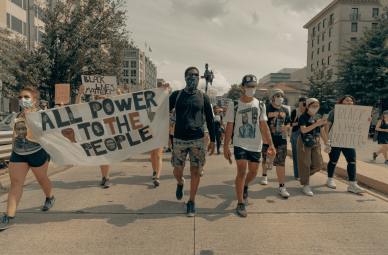
Photo by Clay Banks
 Making Change Collective